Clank!
- 4.8
- Rating
- 10.00K
- Installs
- $10.99
- Price

 Analysis by App-foxy
I approached Clank! as someone who enjoys board games but does not always want to clear a table, sort cards, and explain every rule before playing. This digital version from Dire Wolf Digital brings the deck-building adventure to a phone or tablet, while keeping the central tension intact: improve your deck, push your luck, and decide how far into danger you are willing to go before making your escape.
That last decision is what makes the game interesting for me. It is not simply about collecting the strongest cards or racing through a fixed set of turns. A good run can unravel because I become too greedy, draw the wrong combination, or stay underground one move longer than I should. The result feels closer to a compact board-game session than to a casual time-killer, so I would recommend it most strongly to players who like making plans while accepting that luck can interfere.
What the digital board-game experience feels like
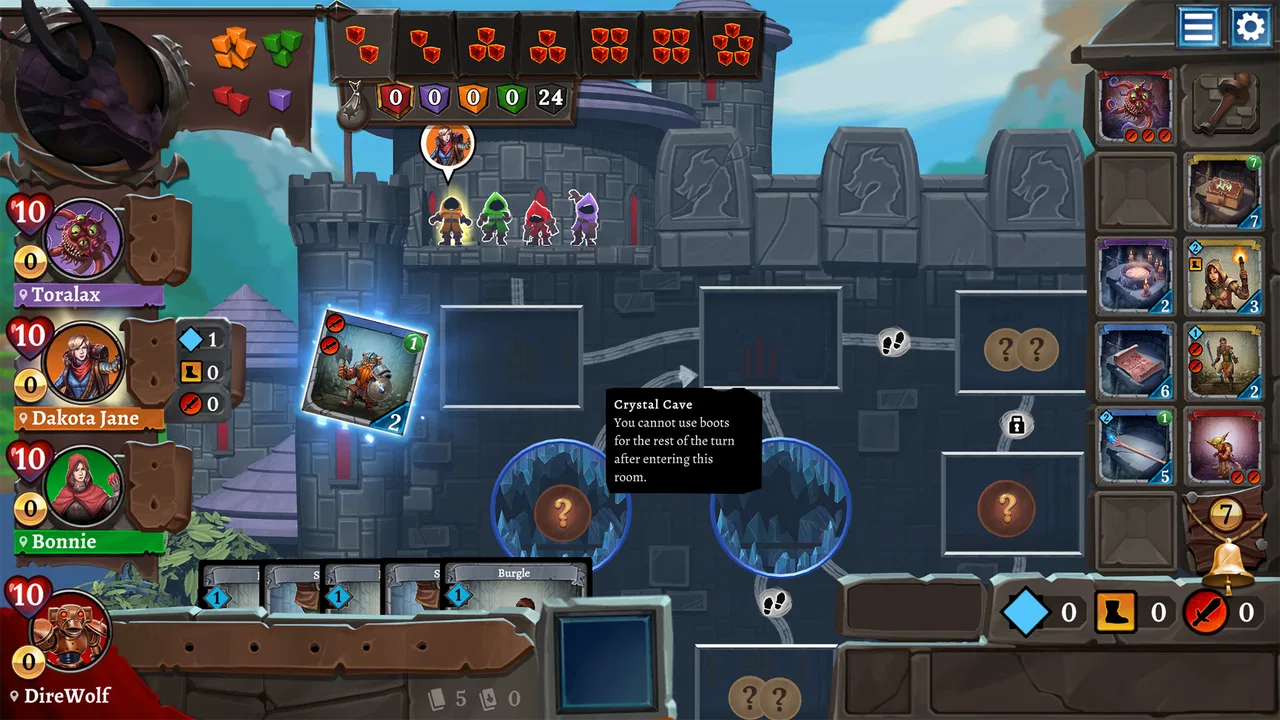
Clank! sits firmly in the board-game category, but its appeal comes from combining several familiar ideas rather than relying on one gimmick. I build a personal deck, use cards to move and interact with the board, search for valuable rewards, and try to get back out before the growing danger catches up with me. Each choice affects later turns because the cards I buy or acquire become part of the deck I will draw in the future.
You May Also Like

 Blood Strike: 2.5 Anniversary
Blood Strike’s Loadouts Turn Every Drop Into a Tactical Gamble
A close look at Blood Strike’s custom loadouts: how fast access to signature weapons reshapes its battle royale rhythm, rewards preparation, and narrows the gap between fights.

 Pandora - Music & Podcasts
Pandora’s Music Is Easy to Start, but Harder to Recover
Pandora’s strength is its low-effort path from a seed to a station. Its weak spot is how much confidence it asks you to place in connection, setup, and quiet recovery.

 8 Ball Pool
 Is Built on Rivalries, Rematches, and Routine
A close look at the rivalries, rematches, shared routines, and unanswered safety questions that turn a quick pool match into a persistent mobile community.

 Samsung Music
’s Quiet Strength Is Playing What You Already Own
Its reach comes less from spectacle than from dependable access to a personal library. That simplicity is both the app’s strongest retention engine and its ceiling.

 AccuWeather: Weather Radar
AccuWeather Review: A Quick, Clear Forecast for Everyday Decisions
For everyday plans, the best forecast is the one you can understand quickly. AccuWeather makes rain timing, radar, and local conditions easy to act on, with a few trade-offs.

 Hill Climb Racing
Why Hill Climb Racing Still Turns Crashes Into One More Run
A tiny car, a bumpy hill and one more upgrade: Hill Climb Racing keeps resurfacing because its simple chaos makes every near-miss feel personal.
More From Our News Desk
View All News


That creates a useful rhythm. Early turns are about establishing movement and resources. The middle of a game is where I start weighing valuable targets against the route home. Near the end, even a modest reward can feel more important than another ambitious detour if my position is vulnerable. The game asks me to read the board, not merely to chase the largest number on a card.
The mobile format is especially useful when I already know the physical game or want a more contained way to learn it. The rules are handled by the software, which removes much of the bookkeeping that can slow down a tabletop session. I do not need to remember every interaction manually, and I can focus on why a move is good rather than whether I have calculated it correctly.
There is still a learning curve. A first-time player may understand the individual card effects before understanding the larger tempo of a run. Movement, deck quality, danger, and the timing of an escape all matter together. I found that the game became clearer after I stopped treating every turn as a chance to maximize immediate treasure and started thinking about the condition of my deck several turns ahead.
The presentation also changes how approachable the board game feels. A physical copy can be satisfying because of the cards and pieces, but it demands preparation and space. Here, the main advantage is convenience. I can begin a session without setting up a table, and the interface keeps the board state available while I consider my options. That convenience does not make the game shallow; it simply removes some of the physical work around it.
At the same time, this is not the best choice for somebody looking for a very quick, mindless round. The decisions can become absorbing, and a player who is learning the systems may need patience before the strategy feels natural. If I only have a minute or two and want immediate action, a simpler puzzle or arcade game would fit better. Clank! rewards attention, even when the individual turn looks straightforward.
Starting without feeling lost
The game costs $10.99, so I would approach it differently from a free download that I can casually remove after a few minutes. The price makes sense for someone who expects to return to a substantial board-game adaptation, but it is worth knowing what kind of commitment that implies. This is a game to learn and revisit, not a disposable novelty.
Its age rating is Everyone, which makes it broadly approachable from a content perspective. That should not be confused with automatic strategic simplicity. Younger or inexperienced players may still need time to understand why an apparently profitable move can create problems later. In my view, the mechanics are more demanding than the rating might suggest, although the theme remains accessible.
The release arrived on October 4, 2024, and the current version is 3.0.3. On Android, the listed minimum operating-system requirement is version 10. That is useful to check before purchasing, especially if the device is older. I would also leave enough storage and battery for a comfortable session rather than treating this as an emergency game for an aging phone.
After installing, my practical advice is to begin with the most guided learning option available rather than jumping straight into an ambitious challenge. The first goal should not be to collect the rarest reward. It should be to understand the sequence of a normal turn: inspect the available cards, identify what each symbol or resource contributes, move with a reason, and then consider what the resulting deck will look like later.
Before confirming a move, I recommend pausing for a few seconds to look at the route back. New players naturally focus on the next room because it offers something attractive. The more useful question is whether the new position leaves a realistic path to safety. That small habit prevents one of the most common early mistakes: entering a promising area without a plan for leaving it.
It is also helpful to treat the first session as a lesson in timing rather than as a test of skill. A failed escape does not mean the whole system is unfair. It often shows that I crossed the line between productive risk and unnecessary risk earlier than I realized. Once I began noticing that pattern, later games felt less random because I could identify the decision that created the problem.
How to reach a meaningful first success
For a first successful run, I would aim for a modest objective: build a deck that performs reliably, claim a worthwhile reward, and leave before the board becomes impossible to manage. That may sound less exciting than chasing the biggest prize, but it teaches the most important relationship in the game. Progress only matters if I can convert it into a safe return.
In the opening, I look for cards that help me do more than one useful thing over time. A card that supports movement, resources, or deck improvement can be more valuable than a flashy card that looks powerful in isolation but does not fit the rest of my draws. The exact choice depends on what appears, so I avoid following a fixed shopping list. The better habit is to notice what my deck is missing.
One non-obvious lesson is that deck quality is not measured only by the strongest card I own. A single impressive addition can be diluted by a deck full of weak or poorly connected cards. I get better results when I ask whether a purchase will appear often enough to matter and whether it supports the route I am already taking. This is especially important for beginners, who can mistake variety for strength.
Another useful technique is to separate exploration from escape in my thinking. During exploration, I accept some uncertainty because I am trying to improve my position. Once I decide to leave, I stop evaluating every nearby reward as if it were still part of the plan. That mental switch is powerful. Many bad endings happen because a player has already chosen safety but keeps making exploratory decisions.
When a first run goes well, the success feels meaningful because it reflects several small judgments rather than one lucky draw. I have to recognize a useful card, choose a route, manage the pressure around the board, and resist the temptation to overstay. That layered decision-making is the reason I keep coming back to this game instead of treating each session as a one-off race.
Playing on a phone also changes how I handle information. On a smaller screen, I take extra care to inspect card text and board details before acting. I would not rush through a turn while distracted, because a missed symbol or route detail can affect the entire plan. A tablet is likely more comfortable for extended sessions, while a phone is convenient for shorter focused games when I can give the screen my full attention.
Where first-time players commonly stumble
The most common confusion is understanding why a move that appears profitable can still be strategically poor. The game tracks several pressures at once, and they do not all reward the same behavior. A card may improve my deck but slow my immediate escape. A valuable location may be reachable now but leave me too far from safety. A strong turn can therefore be bad if it arrives at the wrong point in the run.
I also had to adjust to the difference between visible progress and actual progress. Moving deeper into the board feels like advancement, but distance alone does not guarantee a better outcome. Sometimes the correct play is to consolidate what I have already gained. If I keep measuring success by how much territory I enter, I will repeatedly underestimate the cost of the return journey.
Card text deserves careful attention, particularly when several effects can be combined. New players often read a card only for its headline benefit and overlook how it interacts with the rest of the hand. I recommend checking the whole hand before committing to a route. The best turn may come from combining modest effects rather than using the most obvious card immediately.
There is a second, subtler confusion around deck-building choices. Buying a card is not automatically progress. It changes the probability of future hands, and that change can be helpful or harmful depending on the deck's current balance. I try to avoid adding cards simply because I can afford them. If a purchase does not support movement, useful resources, or a clear strategic direction, leaving the deck alone can be the cleaner decision.
Luck can also be misunderstood. Draws matter, and a bad hand can certainly hurt, but the game gives me many opportunities to reduce the impact of bad luck through preparation. A route with several fallback options is safer than one that works only if the next hand is perfect. I judge the game more fairly when I evaluate the quality of my plan across several possible draws rather than blaming one unlucky turn.
There is some friction in learning the interface and the rules at the same time. Digital board games can be less socially transparent than their physical counterparts because other players are not sitting beside me to explain a confusing interaction. If I am introducing the game to someone who dislikes reading rules, the physical version or a simpler digital board game may be friendlier. The app is best for people willing to learn by examining the board and reflecting on mistakes.
Who will get the most from repeated sessions
Clank! is a strong fit for players who enjoy deck-building but want the deck to serve a larger adventure rather than exist as an abstract card puzzle. It is also a good match for people who like push-your-luck decisions with consequences that develop gradually. I enjoy that a run can begin conservatively and then become tense when the rewards start to justify greater danger.
The game works well in an everyday scenario where I have a quiet block of time but not the energy to organize a tabletop session. For example, after dinner I can play one focused run on a tablet, pause to consider a route, and return later without needing to leave cards spread across the table. That makes it more practical than the physical alternative for solo practice or for learning the structure before teaching friends.
It is less suitable for somebody who wants a purely competitive social experience. The physical board game has a tactile and conversational quality that a screen cannot fully replace. If the main pleasure comes from negotiating face to face, watching another player take a risky step, or physically handling the components, the digital adaptation will feel more efficient than atmospheric.
I would also hesitate to recommend it to players who dislike games where a good plan can still be disrupted by a draw. The randomness is part of the tension, but it means perfection is not always possible. Players who prefer deterministic puzzles may be happier with a game where every failure can be traced to a precise logical error.
The listed average rating is 4.8 from around 2.2 thousand ratings, with over 10 thousand installs. Those figures suggest that the adaptation has found a receptive audience, but I would not use popularity as a substitute for matching the game to my own preferences. The important question is whether I enjoy balancing deck improvement with the decision to turn back.
Costs, replay value, and the next step
The purchase price is $10.99, and the game also lists in-app purchases at $8.99 per item. That combination is worth considering before starting. I would make the purchase only after deciding that I want a full board-game experience on mobile, rather than expecting a free, lightweight introduction. The additional purchase structure may also matter to players who prefer a single, clearly bounded payment.
For me, replay value comes from improving judgment rather than merely unlocking a longer sequence of content. I want to see whether I can recognize danger earlier, build a more coherent deck, and choose a better moment to leave. A session can therefore teach me something even when I do not finish with the best reward. That is a healthier reason to replay than chasing a number without understanding the decisions behind it.
My next step after a first successful run would be to change one habit at a time. I might focus on leaving earlier, then compare that result with a more ambitious attempt. I might also try building around a different card pattern instead of copying the first strategy that worked. This controlled experimentation makes the game easier to understand because I can see which decision changed the outcome.
It is worth keeping a mental note of why a run failed. Was I too deep, did my deck lack movement, or did I spend too long chasing a reward? That simple review turns frustration into useful information. The game becomes considerably more satisfying when each loss gives me a specific adjustment for the next attempt.
Dire Wolf Digital has made an adaptation that preserves the central appeal of a tense deck-building board game while removing much of the setup burden. I like it because the important choices remain visible: what to add to the deck, where to go, and when to stop. The limitations are equally clear: it asks for attention, its randomness will not suit everyone, and the digital format cannot reproduce the social feel of a physical table.
My recommendation is straightforward: choose Clank! if you want a thoughtful board-game adventure that rewards repeated learning and careful risk management. Skip it if you need instant, low-commitment entertainment or if the tactile and social parts of tabletop gaming matter more to you than convenience. For a first-time player, the safest path is to pursue a modest reward, study the route home, and treat the first escape as the real victory. That approach makes the game welcoming without taking away the tension that gives it character.
FAQs for Clank!
01What is Clank! and how is the game played?
Clank! is a deck-building adventure game in which players explore a dangerous dungeon, collect treasures, defeat enemies, and try to escape before the dragon becomes too enraged. Each turn, you play cards to generate movement, skill, and combat power. Your choices affect both your progress and your risk, so rushing for valuable loot is not always the safest strategy.
02Is Clank! suitable for beginners and casual players?
Clank! can be enjoyed by newcomers, although its combination of deck building, dungeon exploration, and push-your-luck mechanics may require a short learning period. The basic actions are easy to understand, but making effective decisions takes practice. New players should begin with a slower, exploratory approach and pay close attention to how noise, health, movement, and treasure influence the final result.
03Can Clank! be played solo or with other players?
Clank! is primarily designed as a competitive multiplayer experience, where players race to collect valuable artifacts and escape the dungeon. Depending on the version or platform, solo or alternative play options may be available, but the strongest part of the game is usually its interaction between players. Competing for cards, treasures, and safe routes creates much of the tension.
04Does Clank! require an internet connection or in-app purchases?
The exact requirements depend on the edition and platform you download. Some digital versions may need an internet connection for initial setup, updates, account features, or multiplayer functions, while other gameplay modes may work offline. Before installing, check the store listing for connection requirements, supported devices, and whether expansions, cosmetic items, or additional content are offered as separate purchases.
05What should I know about difficulty, game length, and replay value?
Clank! is not simply a fast race; games can become increasingly tense as the dragon attacks and players decide whether to continue exploring or return to safety. A typical session may take a significant amount of time, particularly with several players. Replay value is strong because card combinations, dungeon routes, and player decisions create different strategies in each game.
Pros
- Quick
- easy-to-learn gameplay suitable for short sessions.
- Distinctive robot-themed presentation gives the game personality.
- Tactical choices make even simple matches feel engaging.
- Works well for casual play without requiring long time commitments.
- Clear objectives help new players understand the basic mechanics quickly.
Cons
- Limited content may reduce replay value for experienced players.
- Some matches can feel repetitive after extended play sessions.
- Progression may feel slow without frequent rewards or new challenges.
- Small interface elements can be difficult to use on some phones.
- The game may appeal mainly to fans of its specific strategy style.

Clank!
Gallery